

Face Masks in Japan: Rules vs. Reality (2025)

Japan was behind the world in reopening, and as COVID-19 is now endemic, Japanese continue to wear face masks more commonly than almost any other country. This covers Japan’s face mask rules, laws (or lack thereof), and expectations, as well as other health safety measures and our experiences with masking in Tokyo, Kyoto, Osaka & beyond.
Japan’s masking culture has been well-documented elsewhere, and we aren’t pretending to be ‘pioneers’ on this frontier. However, much has not been discussed in the context of travel in 2025. Additionally, we were surprised and frustrated on a number of occasions by other health protocol–or the lack thereof–and the contradictions in Japan’s approaches. Accordingly, we’ll share under-discussed details about Japan’s approach to the pandemic and its aftermath, how that impacts travel, and other thoughts.
Two years ago, Japan’s government drastically eased face mask guidelines. Under the new guidance, people are only recommended to wear face masks on public transportation during rush hour or when there’s congestion. Students are no longer requested to use masks during school activities. In effect, masking recommendations officially ended over a year ago.
The government stated that this was done to relax health restrictions for economic and social activities. It came ahead of the legal downgrading of COVID-19 to the same category as common infectious diseases like seasonal flu, which itself occurred over a year ago.
There has never been a legal mask mandate in Japan, but mask-wearing has become a daily custom among citizens for around three years. The decision to put on a mask, indoors or outdoors, will be left to individuals. All of this occurred over a year ago, and there’s not really any continued coverage of masking in the Japanese media, nor is there any ongoing government guidance.

Our most recent trip to Japan occurred in late 2024, during which time, we’d estimate that approximately 25% of Japanese people still wear masks in public at any given time.
That number is fairly consistent with our previous visit over the summer, and it’s possible that the lack of a drop between the two visits could be seasonality–it was hot in the summer and cold in the winter, making one of those times more conducive to masking.
In any case, these numbers aren’t too out of line with 2019 and earlier. Masking has always been more common in Japan than the West, with the number of people wearing them being around 20% or so and also varying by season. At least, that’s how it seems. People wearing masks were more noticeable in ~2019, as it wasn’t something the rest of the world saw (yet) with any degree of frequency. Now, everyone else has been exposed to masking, so it probably doesn’t stick out as much.
Suffice to say, you probably won’t notice face mask wearing in Japan as of 2025 unless you’re really looking for it (as we were, for the sake of updating this article). It’s now a minority of locals (and very few visitors), and probably not all that dissimilar from what we see in Los Angeles on any given day. As such, we’ll no longer be updating this article–but will preserve it for posterity.

In practice, everyone we know who has visited Japan in the last year has been comfortable not wearing masks at all. In actuality, at least one-quarter of Japanese are not wearing masks in any given space (including crowded trains) and it’s often the case that half or more of all people in tourist areas aren’t masking up at all.
To each their own, but we haven’t talked to anyone who has felt uncomfortable or disrespectful by not wearing a face mask in Japan since May. There’s a critical mass of locals not masking in any place that it feels sufficiently normal and appropriate. Unless you’re still skeptical, incredulous, or just want a lot more background about masks in Japan, that’s really all you need to know.
Another thing that’s worth knowing is that, based on survey data from Japanese public broadcasters, 50.2% of the Japanese who wear masks do so out of habit. It’s not an antivirus measure, it’s become a custom. Other respondents pointed to social anxiety, an unseen pressure to conform, a desire for anonymity, or–and this is not a joke–to “avoid the need to wear makeup or groom one’s face” and “feeling that it looked good as a fashion choice.”
Point being, the Japanese who are masking out of habit or for social conformity, anxiety, or to avoid wearing makeup are not going to care in the least what foreign tourists are doing. Statistically speaking, the overwhelming majority of the Japanese who do mask believe that it should be a personal choice whether to mask or not. They do not care what you do.

To that point, Japan’s Ministry of Health, Labor and Welfare dropped all of its “rules” (really just recommendations) for masking and now simply states the following: “Due to the reclassification of COVID-19 into Class 5 last May, individual choice is now respected, and the implementation of infection control measures is left up to the judgement of individuals and business operators in principle. Please remember not to force people to wear masks or take off their masks.”
Here are other “points to consider” with regard to masking according to the Ministry of Health:
- When considering mask usage, it is important not to hinder the healthy growth and development of children.
- Stronger infection control measures may be required, such as calling on people to wear appropriate masks temporarily according to the situation. Even in such cases, there are concerns about the impact on the health of children wearing masks, so we ask parents and adults around them to continue to pay close attention to the physical condition of each child.
- Wearing a mask is left to the discretion of the individual, but it is permissible for businesses to require customers or employees to wear masks for infection control or business reasons. However, if it is difficult to wear a mask, due to disability, etc., please consider the individual circumstances and give sufficient consideration to prevent discrimination.
- Please be careful not to force a person to put on or take off a face mask against their will.
The rest of this post is outdated, and was written prior to the legal downgrade and Japan encouraging ‘individual choice’ with regard to masking…

When it comes to commentary, we’ll start with a bit of ‘background’ since face masking has been a controversial topic, so you can assess our level of risk baseline tolerance, etc. Since masking became commonplace in the United States, we’ve resided in Florida and California. If you’re not an American, those two states have had essentially diametrically opposed approaches to masking.
For our part, we masked up consistent with CDC guidelines, more or less, using KN95 masks when community spread was at its worst in year one. I was personally “over” masking once vaccinated. The last time I wore a mask with any degree of consistency was prior to California’s mask mandate expiring. Aside from when complying with rules of private businesses (or statewide mandates), I have not masked by choice in almost two years.
My personal basis for being “over” masking after vaccines were available was essentially if not now, when? Meaning that if a population is no longer immunologically-naive, and long-lasting protection against severe disease exists due to durable immune memory of B and T cells, why continue masking? What other basis is there for rolling back health safety measures given the now-endemic nature of COVID?

At that point, I had enough risk tolerance and am sufficiently low-risk that my personal assessment was that continued burden of masking outweighed its value. To whatever extent it works at all, one-way masking is a viable alternative and high-quality masks are widely available. The onus is on the individual to take their health and safety into their own hands.
With that said, my view on masking is: to each their own. What other people do is their business, and does not impact me. If others want to mask indefinitely, that is their prerogative. While we no longer mask, we do take certain mitigation measures when convenient and if community spread is higher.
For example, we dine outdoors much more frequently than before, especially during times of year when spread is surging (and the weather is pleasant in Southern California). I realize much of this is a very ‘westerner’ way of thinking, but…that’s what I am! This is merely my perspective to offer greater context about my perception of masking in Japan. I am not looking to relitigate any masking debates.

Despite the aforementioned guidance, the vast majority of Japanese mask almost everywhere. That includes outdoor locations, even while hiking in mountain temples and other rural areas where few others were around. The airports in Tokyo and Osaka were the places where we saw the fewest masks the entire trip.
Some might shrug this off, noting that masking has always been commonplace in Japan. That’s partially true–masks have been a thing, especially since the SARS and MEARS outbreaks. However, I cannot recall ever seeing more than 10-15% of the population masked. It was never like this before.

To be sure, masking in Japan is no longer 100%, but it’s still a strong majority of people.
However, there are a few caveats to this. First, those highly-scientific statistics are (obviously) only my observations; masking is something of which I was acutely aware and paid attention in order to cover here. Second, those numbers include anyone wearing a mask in any way.

To that point, there are a good number of people–especially younger and older men–who wear face masks as chin straps. In addition to those individuals, many people only mask their mouths, leaving their noses exposed.
Perhaps most interestingly, the number of people I observed wearing properly-fitting, high-quality masks was exceedingly low. KN95s or above are very rare; more people are wearing surgical or cloth masks.

Given all of that, it should thus be relatively unsurprising that Japan is largely going through the motions when it comes to other health safety measures. The approach epitomizes hygiene theater, with the visible signals of supposed-safety mattering more than actual mitigation.
This was reinforced throughout Japan, but nowhere more than on public transportation.

More than anywhere else, masking was universal aboard trains. Over the course of a month, I saw 3 Japanese people without masks on trains. As with anywhere else, I did spot plenty of noses.
Notably, trains were packed during busy times and there was no discernible difference between now and this exact same time pre-pandemic. These densely-packed trains were unsurprising, as remote work never really ‘caught on’ in Japan to the extent that it did elsewhere.
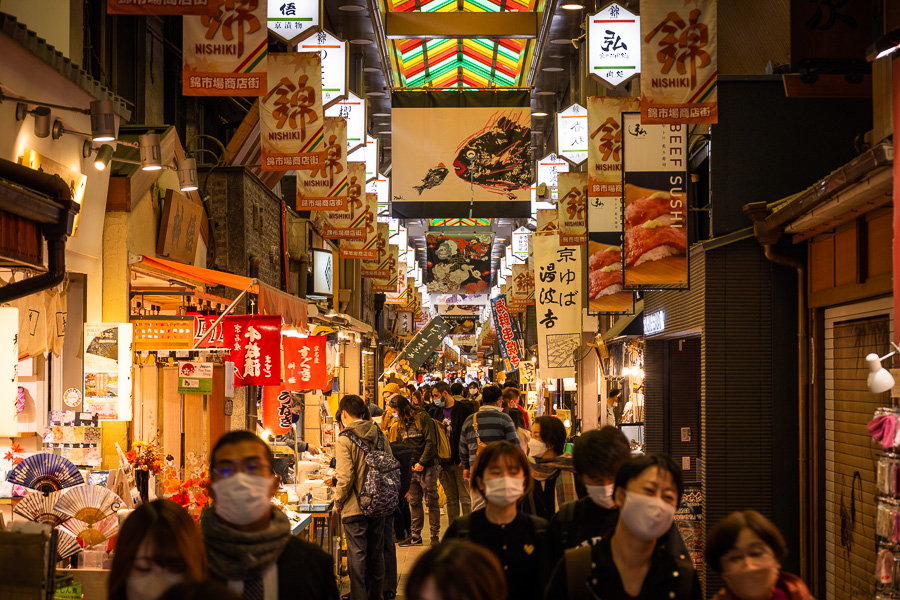
On top of that, we routinely saw windows with labels indicating that they were left open for ventilation. A wise idea to reduce the likelihood of transmission…had it been true. Many of these windows were closed (presumably by riders as the weather turned colder?) and some trains had no open windows whatsoever.
Worse yet, it was incredibly common to hear non-stop coughing and sneezing. I lost count of how many times we move seats on a train because someone near us was visibly sick. (But don’t worry, they were wearing a cloth mask!) In fact, it was an incredibly common sight to see people remove their masks to cough or sneeze.

Beyond the universal masking, hand sanitizing stations and temperature check stations that no one was checking were both common. Still uncommon was soap in restrooms, at least outside of Tokyo.
Speaking of restrooms, virtually all hand dryers were out of service “for safety.” This is one of the things I had to research, as this was a new-to-me phenomenon. Supposedly, the government reversed this decision almost two years ago at the behest of the Japanese Business Federation. Apparently the operator of virtually every restroom in Japan didn’t get the memo.
It’s always been the case that you should travel with a towel to dry your hands in Japan; now that’s the only option.

At restaurants throughout Japan, plexiglass dividers are still fairly commonplace, but are also (finally) starting to decrease in usage.
This is particularly amusing in ramen shops and other older, intimate settings. They are packed with people and have zero ventilation, but don’t worry, there’s a piece of plastic that barely rises to nose-level!

To be clear, the lack of ventilation and ‘improper’ mask-wearing does not bother me from a health safety perspective. Rather, it’s the hypocrisy of it all. It’s difficult to take the health measures seriously when they are half-hearted and largely symbolic. It comes across as performative rather than a sincere caution or desire to reduce risk. I can’t be sure why masking is nearly universal, but it doesn’t seem to be entirely due to concern about COVID at this point.
If masking is truly important culturally, so be it–but at least cover noses or wear high-quality masks with greater efficacy. If reducing transmission in crowded spaces is critical, discard the plexiglass and crack a window or door. The list goes on and on. It should not be the case that visible measures are always favored over invisible ones, even those that are demonstrably more effective at mitigation.

For my part, I mostly followed the face mask guidance from Japan’s Ministry of Health, Labor and Welfare. Actually, I went “above and beyond” (although it definitely did not feel like it). I wore a cloth face mask at all times indoors and on public transportation.
Outdoors, I typically did not mask. (At least, not properly; lots of chin-masking and nose-out masking in these scenarios.) There were exceptions to this, such as private places of business with rules requiring masks. For example, Universal Studios Japan requires masks “at all times” in the park and I followed that in full. For the comfort of others, I also wore a mask properly in densely-crowded outdoor areas, such as nighttime illuminations in Kyoto, which were busier than I had ever seen.

There were certain situations where I used my own discretion and did not mask. Both Fushimi Inari and Kuramadera in Kyoto had (weathered) signs up encouraging or requesting face masks. I’m not sure whether these policies are actually still in effect, but we visited the former after 10 pm when no one was around and the latter on another uncrowded day.
Not once was I confronted about not wearing a mask outdoors, and I didn’t notice any side-eye or judgmental stares. Japan is always a mixed bag when it comes to treatment of cultural outsiders, and this is often so subtle as to be unnoticeable. We didn’t perceive any better or worse treatment than normal, and the Japanese in general were as welcoming as ever. Masks, or lack thereof, seemed to be a complete non-factor in how we were perceived and received.

As indicated above, I’m sharing our experience because this has been a common query. Many of you have indicated that you’re waiting to visit Japan until “things are back to normal.” From my perspective, that seemed like a sensible position.
Or it did before we took this trip. This is for two reasons. First, because of our reception and just how shockingly normal everything already is, minus the masks and assorted hygiene theater. Given that alone and its minimal intrusiveness, there’s really no reason to wait.
Second, because there’s no telling when Japan might be “fully” normal. Our experience might be the new normal for the foreseeable future. Again, it’s a matter of if not now, when? Vaccinations plus boosters have not been enough. Nor has government guidance. Same goes for eight waves and a lengthy stretch during which Japan had the most recorded cases in the entire world.
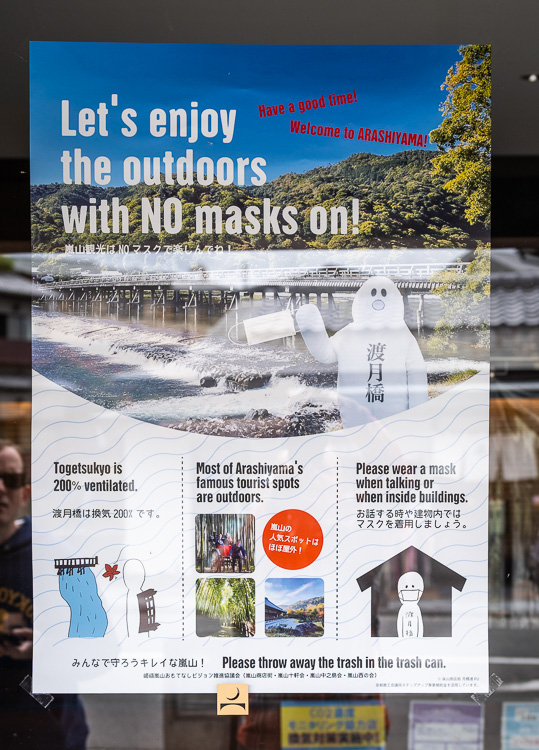
None of this changed the equation, so what will? Optimistically, I’d like to think that opening up to the world and seeing foreign tourists without masks might give those who have mask fatigue “cover” to likewise remove their masks.
However, it’s just as likely that such behavior will be used to feign superiority or as the purported cause of future waves. Already, precisely this is happening, with Japanese media drawing a tenuous connection between reopening and the eighth wave. Japanese social media feigns righteous indignation at images of maskless foreigners.

More likely, it will take better messaging from Japan’s government. In one survey last year, 72.7% of respondents indicated that they are in favor of dropping the practice of masking, but 58.4% were unaware that the government had already dropped its guidance for masking outdoors.
This was consistent with our (admittedly limited) experience talking to friends while visiting Japan. When we inquired about masking and other safety measures, the consensus was that the practices were done so because the government requires it. (In these and other past conversations, we’ve learned that questioning the “why” of rules or recommendations is a western thing.)
Past surveys have suggested that peer pressure is also a powerful factor, with people modifying their behaviors based on how others act. While a majority no longer wanted to mask, over 90% felt compelled to do so because everyone else was. Another older survey indicated that some favor masking for reasons having nothing to do with COVID–anonymity, insecurity, etc.
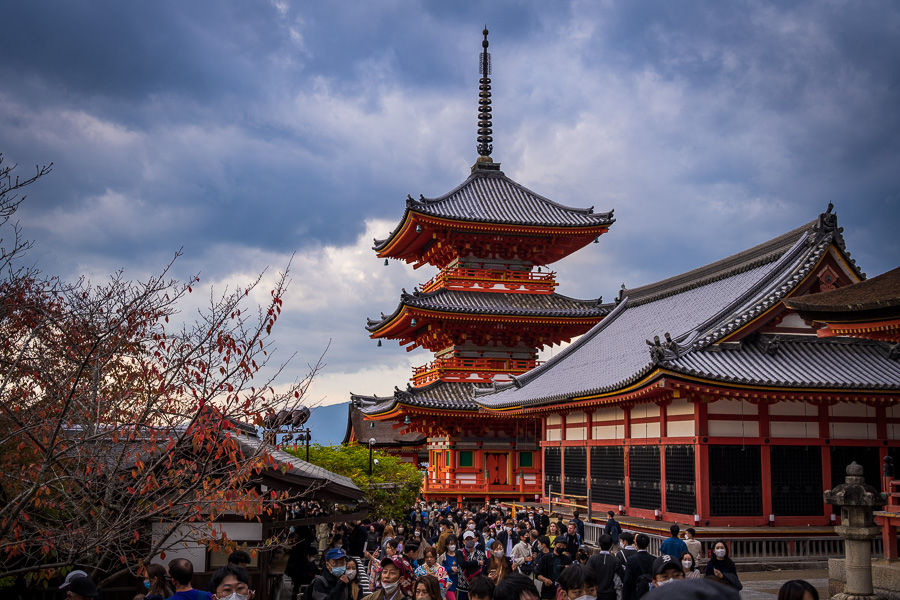
Kazuya Nakayachi, a psychology professor at Kyoto’s Doshisha University specializing in trust and risk perception, recently reiterated this, telling Kyodo News that although people think masks offer some protection against the virus, much of the motivation in donning them comes from wanting to fit in with the crowd with “appropriate behavior.”
“Various surveys indicate that along with a strong pressure to conform, there is an informational influence at work in which people seek cues in their surroundings for deciding what is the right course of action. I think people continue to wear masks because they are attuned to each other and behave accordingly,” Nakayachi said.
Nakayachi added, “much in the same way mask-wearing has partly been a result of social conformity, so too will mask removals.” His belief is corroborated by the Japanese individuals interviewed by Kyodo, many of whom indicated they’d unmask as soon as others stopped masking. Other experts predicted that this would occur within the next two years, with face masks flying off en masse, due to a mixture of decreasing cases, declassifying COVID-19, and grueling weather.

Ultimately, it’ll be interesting to see the degree to which Japan’s masking practices, social expectations, and rules/recommendations change. While we question what could conceivably happen to trigger different behavior, it’s worth a reminder that this was the same perspective many had about the border closure itself.
As with so many things, change happens gradually, then suddenly. It may be difficult to envision the status quo shifting after three years, but it’s even more difficult to imagine this continuing for decades to come.

As for recommendations regarding masking in Japan, we’ll simply reiterate prior advice: you are a guest in another country, so it is appropriate to act accordingly. In our view, that is done by following the letter of official public health guidance and any rules that private businesses might have in place.
Irrespective of your beliefs, that’s what you agree to when entering the country and patronizing those establishments, respectively. Whether you want to go ‘above and beyond’ for the sake of social conformity or being culturally respectful is your prerogative. We did in many settings, but not always in uncrowded settings. Of course, your mileage and views may vary. We’re simply here to share what we experienced and observed.
If you do opt against wearing a mask, it’s highly unlikely anyone will say anything. The only times we ever saw this occur were at a Hilton breakfast buffet in Tokyo (masks were required when getting up to get food) and at Universal Studios Japan. Everywhere else, people were left to their own devices. This is hardly surprising. The Japanese are typically non-confrontational, opting instead for passive-aggressive slights to which foreign visitors are mostly oblivious.
If you’re planning a trip to the Japan, check out our other posts about Japan for ideas on other things to do! We also recommend consulting our Ultimate Guide to Kyoto and Ultimate Guide to Tokyo to plan.
Your Thoughts
If you’ve visited Japan since the border reopened for travel, what was your experience with masking? Will you travel to Japan in 2025, or are you still waiting for things to fully return to normal? Thoughts about any of the health safety measures or hygiene theater discussed here? Any thoughts or tips of your own to add? Any questions? Hearing your feedback about your experiences is both interesting to us and helpful to other readers, so please share your thoughts or questions below in the comments!


I find your blogs very informative and useful, and I thank you for it.
But this particular one was a little disappointing because you were very critical about the way the Japanese people are handling COVID and sounded like you were saying you know better.
I think, as some people pointed out here, it’s a matter of respect.
I visited Nara and the surrounding area for 2 weeks earlier in November, and I wore a mask whenever I was in public except eating/drinking occasions. It was no big deal. It wasn’t my main focus whether I should wear a mask or not. I was enjoying being there in Japan after 3 long years of waiting. People were kind and respectful. I didn’t have to worry about my safety walking alone late at night. I was happy to be there.
By the way, I found soap in every public bathroom I had to use.
If you told me you take off your shoes inside your home, I wouldn’t walk into your home with my shoes on. No big deal.
If you don’t want to wear a mask, don’t go yet. They treated me with kindness and respect, and I will do the same at any time.
“By the way, I found soap in every public bathroom I had to use.”
I’m surprised you found this to be the case in Nara. In almost all of the rural areas we went in Nara, we found there to be no soap.
In general, there’s a very big rural v. urban divide on this. If you’re in a major city (or even 7-11 or Lawson anywhere), soap in restrooms is the norm. At temples, shrines, and other public restrooms outside major metro areas, it’s far less common.
I agree that it is a personal choice, but people are easily influenced by their environment. How many Japanese and Korean fans have been wearing masks at the FIFA World Cup in Japan? Look carefully, and you will see it’s pretty close to zero percent. For me, that tells you everything you need to know about why people are still wearing masks. Peer pressure and a feeling to follow everyone else.
The same is true in reverse where people in most western cities are looked at as being odd if they are now wearing a mask.
Absolutely. We live in a touristy area of Southern California and seldom see Asian visitors wearing masked. Friends from Japan have come to visit (who always mask at home) and never wore masks, either. One specifically said, “as soon as Japanese land in America, it’s MASKS OFF!” (that gave me a chuckle).
As mentioned in the post, I never wear a mask at home, but did so because of the pressure and out of courtesy in many situations in Japan. I hadn’t planned on wearing one outdoors at all prior to the trip, but ended up doing so quite often.
As a nurse of 30 yrs and over 20 in the ICU my biggest disappointment has been in the medical community. They did not present a united front during Covid. Instead many contributed to the division in this country. I’ve worn N-95 for all of my nursing career when taking care of tuberculosis patients. Every year we get ‘fitted’. There is a choice of 5 to 6 masks, we are test fitted for the best fit. If you cannot find an adequate mask you have to wear a Powered Air Purifying Respirator. So all these one size fits all K95 are also BS. At our hospital we still have to wear the masks and are still limiting visitors. Insane. It’s going to take a long time for health officials to regain many peoples trust. Sad.
My wife was a nurse/MMR specialist who helped develop her hospital’s plan during MERS, so we she was familiar with fit-testing, appropriate masking, (and so forth) at the outset of COVID. However, there was a lot of confusion about the nature of transmission early-on, and I think a lot of nurses and others who otherwise were knowledgeable gave a lot of deference given that. Hindsight is always 20/20, so I give the benefit of the doubt as to what happened early on (and by that, I mean through about August 2020–by that point, we knew a lot more). I agree that a lot of the continuing practices are purely performatory, with literally zero basis in…anything.
(In any case, the KN95s we used to wear were fit-tested.)
Just reappearing for a small news: it seems that *finally* the classification of the virus will be changed. The Lower House passed a modification of the Infectious Disease law with a request to “review” Corona classification before it is approved in the Upper House. A member of the government (Kato, I think?) said today that they will “review” the classification and act accordingly. Finally? (considering all the scandals going around, this news was difficult to find).
As for masking… I won’t when I get there in summer. I refuse to wear something which never worked to begin with.
Thanks for sharing that–totally missed the news!
We just returned from 10 day trip. Whether it’s for show or for real, COVID measures were ever-present. Having made a number of 10-hour airplane flights recently, we were inclined to mask and did so in Japan, as well. It’s incredibly crowded at all times, so just makes common sense. No problem finding soap or drying machines. Paper towels have never been common in Japan. That said, my wife, who is meticulous about COVID, got it anyway. So I recommend masking.
We were visiting Japan in late October, and wore masks at all times outside of our hotel rooms except when eating or drinking. It was the polite way to behave! Onwards to Singapore and masks were only worn on public transport, and enforced by officials. When in Rome…
Great post. In October In Okinawa and mainland I watched in amazement the groups of Japanese young and old all masked up outside who would remove the mask upon entry into a ramen eatery about the size of an suv where they would sit shoulder to shoulder and eat drink smoke and laugh for a couple of hours. In the boiling kitchen you could see the cook toiling away while wearing a mask. As In much of the world, we humans feel more than we think.
Nice article, I was 2 weeks in October. Think you nailed it. I wore mine on public transportation and that was it. My girlfriend who is Japanese, wore hers much more. I asked her why and she said eyes.
November 29, 2022 My wife (73) and I (80) have been traveling independently in Japan for two weeks now (Tokyo/Kochi/Shimanto-cho/Kobe/Yokohama) and our experience is very similar to yours. Mask wearing is practically universal, even outdoors, and yet no one has glowered at me if for a few minutes I omitted to replace my mask.
I live in rural Japan and everyone wears a mask all the time.
We received a communication from the city hall about the ministry’s policy both in Japanese and English.
We were very shocked when we made a trip to Tokyo in summer 2022. We saw a lot of people without a mask whereas in my city it was still 100% masks on.
Travelling to Nagano or other trekking places, climbed Mt Fuji too in early September, people, Japanese people that is, tend to wear the mask less.
Last year even on trekking paths 100% of people wore masks.
I got back from three weeks in Japan just over a week ago, and I concur with your article. Masks were present most places. I did find that the less densely populated the area, the more relaxed people were, with Tokyo being the place with the most compliance.
If you’re doing a lot of physical exertion – walking up the mountain in Fushimi Inari or on Miyajima for instance – it seemed perfectly acceptable to pull your mask down or take it off as long as you were away from people. In these circumstances I generally pulled my mask down, and when walking past someone I would pull it back up if they had a mask, or leave it down if they didn’t. But aside from that I wore masks all the time.
Most of the people that didn’t wear masks in crowded situations were, unfortunately, foreigners, which is a shame.
I did find that it made communication a bit more difficult – Japanese people are usually quite softly spoken, and when you can’t see their lips it can be hard to comprehend what they’re saying. Also as a foreigner with limited Japanese, you tend to rely a lot on facial expressions (smiles / blank face / confused face etc.) which is a lot harder to do when your face is covered!
Although it was a bit strange at first you soon get used to it – to the point that now I’m home I have to remind myself *not* to wear a mask.
Thanks to Tom for all the updates over the last couple of years!
My wife who is Japanese just spent a month in her hometown Tokyo. She adheres strictly to masking, and according to her observation close to 100% of her compatriots were doing the same. She saw only foreigners without masks. I just spent a week in Taiwan and made the same observation. As there are much less foreign tourists in the country compared to Japan, the impression is 100% mask wearing. Many even start hiking in the mountains with masks, but remove them eventually. the old men in an onsen basin in the mountains were all wearing their mask. I did the same, and it did get wet when I was moving my shoulders below the surface.
Thanks again for the imformative update on thr situation. We are looking forward to two weeks over new year. The Visit Japan Website with it’s three QR codes for quarrantine, immigration and customs was easy to set up and will hopefully speed up our entry process.
For us mask wearing is something we will be doing primarily because it is respectful and courteous to our hosts. Of course, as a bonus, they do reduce risk of spreading infection too.
I have a screen with a live feed from Shibuya on all the time and when a rare maskless adult hoves into view it’s a non-Japanese. Even cyclists crossing and at quiet times it is the overwhelming norm.
Martyn, thanks so much for your reply. Good to hear they can help us connect to Airport wifi.
Thanks a lot.
I travelled to Japan the day after the borders fully opened it October. Very much the same in terms of wearing my mask. I did it on transport & when I was in a crowded area. I did a fair amount of hiking and no one was wearing masks up the mountain trails 😅 I did find the lack of hand driers mildly irritating, not having the foresight to carry a towel around with me.
Ultimately I am happy to follow the social convention in Japan, I am a guest to their country, regardless of the science or my belief behind it, if wearing the mask in public spaces allows me to show respect to the Japanese people, then I’m more than happy to do so. I would very much like to go back for 2023, regardless of mask mandate.
I totally agree with you, James.
Tom wrote, “What other people do is their business, and does not impact me.” That is exactly the difference between Japanese and non-Japanese thinking. I believe many Japanese mask (in COVID or flu situation) as they don’t want to infect others AS WELL AS they don’t want to get it. They have strong belief that what they do or say impact others. When we go to other country, we should respect their ways because we are guests to their country.
We go next week. Just to be back there with so few crowds is worth any amount of mask wearing!
I have a question about the Fast Track. We have registered, generated the 3 QR CODES, etc.
At the Quarantine counter must We show the QR code ON THE MOBILE, or can we show a good screenshot or printout?
Same for immigration and customs.
Can someone please let us know their experience.
Thanks a lot!
We are just back. We were required to show QR code on our mobile. Staff helped us connect to airport wifi to get it and were incredibly helpful
Martyn, thanks so much for your reply. Good to hear they can help us connect to Airport wifi.
Thanks a lot.
I was over there earlier this month with a friend. I handled all the paperwork and stuff for both of us, so I had screen images of his QR codes on my phone in addition to the ones for myself, I just had to explain by pointing that I had both our codes on my phone, and we had no issues. As long as they can scan the codes, it should come up in their system and show as completed.
This blog has been incredibly useful for us, thank you, as our daughter moved out to the Kansai region at the end of August, and we were on tenterhooks wondering when we would be able to visit her. It was great to have you monitor the situation for us! We have just returned from a 2-week trip, having worn masks the whole time – our daughter, as a temporary resident of Japan, was keen for us to observe the same protocols as the local people, and felt strongly that it would be disrespectful not to. We got used to it quickly, and it really wasn’t a hassle. In terms of rest-rooms, hand-dryers were off-limits but there was plenty of soap. Temperature-checking was variable – some places had people monitoring the machines, others didn’t. Only thing we worried about was the possibility of developing covid symptoms and having to isolate, something that we have moved on from in the UK. Despite the niggling anxiety about this, it was a wonderful trip – we hope to go again in Spring next year.
I am a Canadian currently in Tokyo having entered in late Oct and plan on staying until mid-Jan. I don’t think how visitors feel personally about masking in Japan is the point. Do it because they are doing it. It is simply showing respect to the Japanese people who are 99 percent masked indoors and out. Period. It is insensitive not to and frankly rude. When you travel you are a guest in the country and I am seeing a lot of gaijin not masking and confirming to the Japanese people that they were right to keep the border shut for so long. The covid per capita numbers are still among the highest in the world and numbers have increased greatly over the last month. Given all the foreign tourists who are walking around unmasked they could easily blame it on us and slam the border shut. Don’t visit if you don’t feel you can wear a mask all the time. It isn’t easy I know, but I Love Japan and I will do anything they ask of me as a foreign guest here. Mask or stay home. It isn’t about you. It is about protecting their people, particularly their elderly. If they shut the border again, with all the unmasked foreigners I see running around I wouldn’t blame them one bit.
I am traveling in rural Japan now after spending a week in Kyoto. I agree with everything you say. When Japan first opened up, I was concerned because of the face masks. A colleague in Japan even said to wait a year when things get back to “ normal.” As you said, there’s no guarantee of that, so here I am.
It really has not been that big of deal. The times I walked out of my hotel rooms and forgot and apologized to the staff, it was no big deal, like they understood the hygiene theatre.
All in all, it was less of an inconvenience than I thought it would be. Kyoto was delightfully uncrowded. Restaurants that had long wait times in ‘19, I could walk right in. Kumara and Kifune were wonderful.
By the way, I stumbled upon your blog several months ago and it has some of the best and most useful I’ve seen about this gorgeous part of the world all in one place. Thank you for your hard work and dedication.
We are planning on going to Japan for 2 weeks in April 2023 for the first time ever. I’ve read about no soap in restrooms before the pandemic– Can’t believe STILL no soap in restrooms there! And now, no hand drying either, wow!
I don’t think I found a lack of soap – or if I did, not frequently enough to remember – but every single handdryer was blocked off and very few bathrooms use hand towels. I actually think it is probably counterproductive, as I saw quite a lot of Japanese people not wash their hands, probably because you can’t dry them. It would be a good idea to take a small hand towel with you, and plenty of hand sanitiser!
We were in Tokyo, Kyoto, & Toyama for 2 weeks beginning November 1. As far as masking is concerned whereas here in the states you have to convince people to wear masks in Japan you have to convince people to take them off. We wore them at all times inside stores, shopping centers, temples, museums etc & on the subway & Shinkansen. Outside especially in non-crowded areas I tended to take mine off – my wife who is Japanese didn’t. Even my wife agreed as you stated this all comes down to “social” norms & isn’t really based on scientific data. Even their emergency conditions during the first 7 waves were a joke. But it wasn’t bothersome for us & really didn’t detract from the whole experience. Even if you don’t wear a mask nobody says anything anyway.